Solution of the toughest logic puzzle ever - the three gods riddle

Click here for the riddle

Solution

First, ask the god standing in the middle, "If I were to ask you if the god to your left is Random, would you say ja?"

If the god says ja, then there are two possibilities: either the god to his left is Random, and the god speaking is either True or False; or the god speaking is Random. Either way, you know the god to his right is not Random.

Similarly, if the god says da, then there are two possibilities: either the god to his right is Random, and the god speaking is True or False; or the god speaking is Random. In this case, you know the god to the left is not Random.

The next step is to approach the god that you know is not Random, and figure out if he is True or False. Because you still do not know the meanings of ja and da, you need to do this by using the same hypothetical structure, asking, "If I were to ask you if you are True, would you say ja?" If the god is True, they will answer ja. If the god is False, they will answer da. (False's response in this case is essentially either: "no I would not say yes," even though he would; or "yes I would say no," even though he wouldn't.)

Finally, now that you have identified a god as either True or False, you can use the same question structure one last time to identify the other gods (you need to stick to it because you still don't know the meanings of ja and da). Simply ask, "If I were to ask you if the god in the middle is Random, would you say ja?" If the answer is ja, then the god in the middle is Random, and the third god is either True or False (the opposite of the one you have already identified). If the answer is da, then the god in the middle is True or False, and the third god is Random.

Congratulations! You have identified the three gods despite their stubborn refusal to speak English. Interestingly enough, you must not waste a question to figure out what ja and da mean, otherwise you would not have enough questions left to identify all three gods. So you leave the archipelago that these gods rule over, and the knights and knaves who worship them, with promises of good fortune and prosperity.

Click Science and Mathematics for more interesting and helpful posts.
Follow me on Quora and Twitter

The hardest logic puzzle ever - The three gods riddle

You encounter three gods. you realize a few things through divine intervention.

First, you know that one of the three gods always tells the truth, another always lies, and the third will respond to questions randomly. Therefore, let us call the gods True, False, and Random.

The gods speak a different language. They understand all languages perfectly well, but only answer questions with either ja or da, the words for yes and no. You do not know which god is which, and you do not know which word means yes and which word means no.

Finally, you have an existential problem on your hands. You may ask three yes-or-no questions, each one directed to only one god, and only that god will answer with either ja or da. If you can determine the identities of the three gods, they will send you on your way with their blessing, and you can be assured of a prosperous and fulfilled life. If you fail to determine the identities of the gods, however, they will be less generous in their treatment. The volcano pit smokes and glows red beside you.

With your three questions, how do you figure out which god is True, which is False, and which is Random?

Hint

To get to this island volcano with the three gods, we took a trip through other islands populated with knights and knaves. These previous encounters will give you the tools you need to identify the gods.

Click here for solution

Click Science and Mathematics for more interesting and helpful posts.
Follow me on Quora and Twitter

Is Your Red The Same as My Red?

This appears blue.
This appears yellow.
And this appears green.
Those of us with normal color vision can probably agree. But that doesn't change the fact that color is an illusion. Color, as we know it, does not exist in the outside world, beyond us, like gravity or protons do. Instead, color is created inside our heads. Our brains convert a certain range of the electromagnetic spectrum into color. I can measure the wavelength of radiation, but I can't measure or observe the experience of a color inside your mind. So, how do I know that when you and me look at a strawberry, and, in my brain, this perception occurs, which I call "red," that, in your brain, a perception like this doesn't occur, which you have, of course, also learned to call red. We both call it red.
We communicate effectively and walk away, never knowing just how different each of our internal experiences really were. Of course, we already know that not everybody sees color in exactly the same way. One example would be color blindness. But we can diagnose and discuss these differences because people with the conditions fail to see things that most of us can.
Conceivably though, there could be ways of seeing that we use that cause colors to look differently in different people's minds, without altering their performances on any tests we could come up with. Of course, if that were the case, wouldn't some people think other colors look better than others? Or that some colors were more complimentary of others? Well, yeah, but doesn't that already happen? This matters because it shows how fundamentally, in terms of our perceptions, we are all alone in our minds.
 Let's say I met an alien from a far away solar system who, lucky enough, could speak English, but had never, and could never, feel pain. I could explain to the alien that pain is sent through A delta and C fibers to the spinal chord. The alien could learn every single cell and pathway and process and chemical involved in the feeling of pain. The alien could pass a biology exam about pain and believe that pain, to us, generally is a bad thing. But no matter how much he learned, the alien would never actually feel pain. Philosophers call these ineffable, raw feelings "Qualia." And our inability to connect physical phenomenon to these raw feelings, our inability to explain and share our own internal qualia is known as the "Explanatory Gap." 
This gap is confronted when describing color to someone who's been blind their entire life. Tommy Edison has never been able to see. He has a YouTube channel where he describes what being blind is like. It's an amazing channel. In one video he talks about colors and how strange and foreign of a concept it seems to him. Sighted people try to explain, for instance, that red is "hot," and blue is "cold." But to someone who has never seen a single color, that just seems weird. And, as he explains, it has never caused him to finally see a color.
 Some philosophers, like Daniel Dennett, argue that qualia may be private and ineffable simply because of a failure of our own language, not because they are necessarily always going to be impossible to share. There may be an alien race that communicates in a language that causes colors to appear in your brain without your retina having to be involved at all. Or without you having to have ever needed to actually see the color yourself. Perhaps, even in English, he says, given millions and billions of words used in just the right way, it may be possible to adequately describe a color such that a blind person could see it for the first time. Or you could figure out that, once-and-for-all, yes or no, in fact, you and your friend do not see the same red.
 But for now it remains the case that we
have no way of knowing if my red is the same as your red. Maybe one day our language will allow us to share and find out, or maybe it never will. I know it's frustrating to not have an answer, but the mere fact that you guys can ask me about my internal experiences, and the mere fact that I can ask my friends and we can all collectively wonder at the concept of qualia is quite incredible, and also quite human.

Animals can do all sorts of clever things
that we do. They can use tools, problem solve, communicate, cooperate, exhibit curiosity, plan for the future, and although we can't know for sure, many animals certainly act as if they feel emotions - loneliness, fear, joy. Apes have even been taught to use language to talk to us humans. It's a sort of sign language that they've used to do everything from answer questions, to express emotion, or even produce novel thoughts. Unlike any other animal, these apes are able to understand language and form responses at about the level of a 2.5 year old human child. But, there is something that no signing-ape has ever done. No ape has ever asked a question.
For as long as we've been able to use sign
language to communicate with apes, they have never wondered out loud about anything that we might know that they
don't. Of course, this does not mean that apes, and plenty of other animals, aren't curious. They obviously are. But, what is suggests is that they lack a "Theory of Mind." An understanding that other people have separate minds. That they have knowledge, access to information that you might not have. Even us humans aren't born with a "theory of mind," and there's a famous experiment to test when a human child
first develops a "theory of mind." It is called
the "Sally-Anne" test.

During the test, researchers tell children
a story about Sally and Anne. Sally and Anne
have a box and a basket in their room.
They also happen to have a delicious cookie. Now, Sally takes the cookie and puts it inside
the box, and then Sally leaves the room. While Sally is gone, Anne comes over to the box, takes the cookie out and puts the cookie
inside the basket. Now, when Sally comes back, the researchers ask the children "where will Sally look for the cookie?" Obviously, Sally will look in the box. That's where she left it. She has no way of knowing what Anne did while she was gone. But until the age of about 4, children will insist that Sally will check the basket because, after all,
that's where the cookie is. The child saw
Anne move the cookie, so why wouldn't Sally also know? Young children fail to realize that Sally's mental representation of the situation, her access to information,
can be different than their own. And apes who know sign language, but never
ask us questions, are doing the same thing.
They're failing to recognize that other individuals have similar cognitive abilities and can be used as sources of information.
So, we are all alone with our perceptions.
We are alone in our own minds. We can both agree that chocolate tastes good. But I cannot climb into your consciousness and experience what chocolate tastes like to you. I can never know if my red looks the same as your red.

But I can ask.

So, stay human, stay curious and let the entire world know that you are.

Thanks for reading

Click Science and Mathematics for more interesting and helpful posts.
Follow me on Quora and Twitter


Only 2 % people can solve this famous einstein's riddle - Can you?


Rumor has it that Albert Einstein made up an impossibly difficult riddle when he was just a kid.

There's no evidence to back up that apocryphal claim, but the rumor earned the popular logic puzzle the nickname "Einstein's Riddle."

Regardless of who actually came up with the riddle, it's not terribly difficult to solve — if you have the patience to think it through. There are no tricks to this riddle. Like Sherlock Holmes, all you need is logic and deduction.

Here's the riddle:

Five houses painted five different colors stand in a row. One person of a different nationality lives in each house. The five home owners all drink some type of beverage, smoke a certain cigar brand, and have a certain kind of pet. But none of the owners drink the same beverage, smoke the same type of cigar, or have the same pet.

And here are the clues:

1. The Brit lives in the red house.
2. The Swede keeps dogs as pets.
3. The Dane drinks tea.
4. The green house is on the immediate left of the white house.
5. The green house's owner drinks coffee.
6. The owner who smokes Pall Mall rears birds.
7. The owner of the yellow house smokes Dunhill.
8. The owner living in the center house drinks milk.
9. The Norwegian lives in the first house.
10. The owner who smokes Blends lives next to the one who keeps cats.
11. The owner who keeps the horse lives next to the one who smokes Dunhill.
12. The owner who smokes Bluemasters drinks beer.
13. The German smokes Prince.
14. The Norwegian lives next to the blue house.
15. The owner who smokes Blends lives next to the one who drinks water.

The question is: Who owns the fish?

Click Here For The Solution

Click Science and Mathematics for more interesting and helpful posts.
Follow me on Quora and Twitter


Solution of einstein's riddle

Click here for the riddle

Let's start by going at the obvious clues:

  • The man living in the centre house drinks Milk.
  • The Norwegian lives in the first house.

After marking these two clues on the board, you'll be able to use this other clue:

  • The Norwegian lives next to the Blue house.
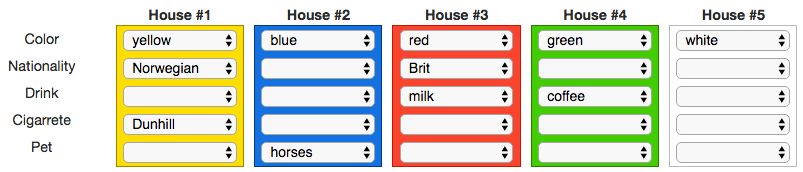
The board after filling in the first 3 clues

Next, we'll be looking at these two clues:

  • The Green house is next to the White house, on the left. (1)
  • The owner of the Green house drinks Coffee. (2)

Since the Green house is on the left of the White house, it can't be the first house (as the house right next of it is blue), obviously can't be the second house because it's blue, and for sure can't be the last one, because it has to be on the left of another house. By using (2), we can see that it also can't be the house of the middle (because the gentleman who lives there likes to drink milk). Therefore, .

After using two more clues

Now, check out this clue:

  • The Brit lives in the Red house.

It's clear that the Brit doesn't live in the first house (the Norwegian lives there), and the only other house that can be red is the middle one. . Also, by elimination, .

After filling the Brit's, the red and yellow houses.

Now you can fill these trivial clues on houses #1 and #2:

  • The owner of the Yellow house smokes Dunhill.
  • The man who keeps Horses lives next to the man who smokes Dunhill.

Now, let's analyze these two clues and focus on the first house:

  • The Dane drinks Tea.
  • The man who smokes Blue Master drinks Beer.

Since we have 5 different drinks, two of them are filled on the board (milk and coffee, on houses #3 and #4, respectively) and both Tea and Beer can't be placed in the first house (as there lives the Norwegian and he likes Dunhill), .

Just after finding that the Norwegian likes to drink water

Lets focus on this clue:

  • The man who smokes Blends has a neighbour who drinks Water.

Since the only neighbor of the gentleman who drinks Water live in the house #2, . Right after filling this one, we see that this other clue can be used:

  • The man who smokes Blue Master drinks Beer.

The man who smokes Blue Master can't live in the first or second houses, since they like to smoke Dunhill and Blends, respectively. Also, he can't live in the third and fourth houses, as their owners likes to drink Milk and Coffee. Therefore, the .

After filling the drink and cigarette on the last house

Now we can see that the owner of the Blue house can only drink Tea, so let's mark that. Now, this clue becomes useful:

  • The Dane drinks Tea.
Now we just filled the info about the Dane/Tea on the house #2

Let's what this clue can tell us:

  • The German smokes Prince.

We can see that the German can only live in the last two houses (the only ones that we don't know the nationality yet). Also, the owner of the House #5 smokes Blue Master, therefore, .

Right after that, we can see that  (the only nationality remaining) and:

  • The Swede keeps Dogs as pets.

After filling all the info about the Swede and the German

Now it's clear that the man who lives in the House #3 likes to smoke Pall Mall and this next clue tells us that he rears Birds:

  • The person who smokes Pall Mall rears Birds.
After figuring out that the gentleman of the middle rears Birds and likes Pall Mall

And that's it! The last clue:

  • The man who smokes Blends lives next to the one who keeps Cats.

Since the neighbor of the right of the House #2 has birds, . And 

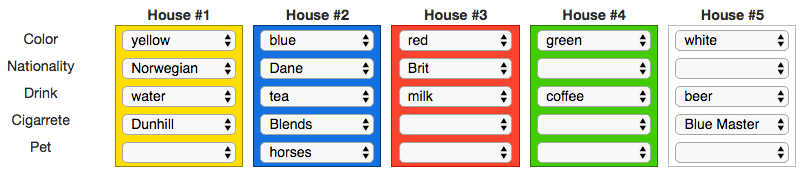
Finally, the complete Einstein's Riddle answer

That's it, I hope you enjoyed 


Click Science and Mathematics for more interesting and helpful posts.
Follow me on Quora and Twitter

Genetic Engineering Will Change Everything Forever – CRISPR


Imagine you were alive back in the 1980's, and were told that computers would soon take over everything: from shopping, to dating, and the stock market, that billions of people would be connected via a kind of web, that you would own a handheld device, orders of magnitudes more powerful than supercomputers. It would seem absurd, but then, all of it happened. Science fiction became our reality, and we don't even think about it. We're at a similar point today with genetic engineering. So, let's talk about it.


Where it came from, what we're doing right now, and about a recent breakthrough, that will change how we live and what we perceive as normal, forever.

Humans have been engineering life for thousands of years. Through selective breeding, we strengthened useful traits in plants and animals. We became very good at this, but never fully understood how it worked. Until we discovered the code of life, Deoxyribonucleic Acid ( DNA ). A complex molecule that guides the growth, development, function, and reproduction of everything alive. Information is encoded in the structure of the molecule. Four nucleotides are paired and make up a code that carries instructions.
Change the instructions and you change the being carrying it. As soon as DNA was discovered, people tried to tinker with it.
  • In the 1960's, scientist bombarded plants with radiation to cause random mutations in the genetic code. The idea was to get a useful plant variation by pure chance. Sometimes it actually worked too.
  • In the 70's, scientists inserted DNA snippets into bacteria, plants, and animals to study and modify them for research, medicine, agriculture, and for fun.
    The earliest genetically modified animal was born in 1974, making mice a standard tool for research, saving millions of lives.
  • In the 80's, we got commercial. The first patent was given for a microbe engineered to absorb oil. Today we produce many chemicals by means of engineered life, like life-saving clotting factors, growth hormones, and insulin. All things we had to harvest from the organs of animals before that. The first food modified in the lab went on sale in 1994: the Flavr Savr tomato, a tomato given a much longer shelf life where an extra gene that suppresses the build-up of a rotting enzyme. But GM food and the controversy surrounding them deserve a video of their own.

  • In the 1990's, there was also a brief foray into human engineering. To treat maternal infertility, babies were made that carried genetic information from 3 humans. Making them the first humans ever to have 3 genetic parents.
Today there are super muscled pigs, fast-growing salmon, featherless chicken, and see-through frogs. On the fun side, we made things glow in the dark. Fluorescent zebrafish are available for as little as ten dollars.
Fluorescent zebrafish

All of this is already very impressive, but until recently gene editing was extremely expensive, complicated, and took a long time to do. This has now changed with a revolutionary new technology now entering the stage "CRISPR".
Overnight, the costs of engineering have shrunk by 99 %. Instead of a year, it takes a few weeks to conduct experiments, and basically everybody with a lab can do it. It's hard to get across how big a technical revolution CRISPR is. It literally has the potential to change humanity forever.

Why did this sudden revolution happen and how does it work?


Bacteria and viruses have been fighting since the dawn of life. 
So-called bacteriophages or phages hunt bacteria. In the ocean, phages kill 40 % of them every single day. Phages do this by inserting their own genetic code into the bacteria and taking them over to use them as factories. The bacteria tried to resist but failed most the time because their protection tools are too weak, But sometimes bacteria survive an attack. Only if they do so can they activate their most effective antivirus system: they save a part of the virus DNA in their own genetic code in a DNA archive called CRISPR.
Here it's stored safely until it's needed. When the virus attacks again, the bacterium quickly makes an RNA copy from the DNA archive and arms a secret weapon "a protein called CAS9". The protein now scans the bacterium's insides for signs of the virus invader by comparing every bit of DNA it finds to the sample from the archive. When it finds a 100-percent perfect match, it's activated and cuts out the virus DNA, making it useless, protecting the bacterium against the attack.
What's special is that CAS9 is very precise, almost like a DNA surgeon. The revolution began when scientists figured out that the CRISPR system is programmable. You can just give it a copy of DNA you want to modify and put the system into a living cell. If the old techniques of genetic manipulation were like a map, CRISPR is like a GPS system. Aside from being precise, cheap, and easy, CRISPR offers the ability to edit live cells, to switch genes on and off, and target and study particular DNA sequences. It also works for every type of cell: microorganisms, plants, animals, or humans. But despite the revolution CRISPR is for science, it's still just a first generation tool. More precise tools are already being created and used as we speak.


In 2015, scientists use CRISPR to cut the HIV virus out of living cells from patients in the lab, proving that it was possible. Only about a year later, they carried out a larger scale project with rats that had the HIV virus in basically all of their body cells. By simply injecting CRISPR into the rats tails, they were able to remove more than 50 % of the virus from cells all over the body. 
In a few decades, a CRISPR therapy might cure HIV and other retroviruses, viruses that hide inside human DNA like Herpes could be eradicated this way. CRISPR could also defeat one of our worst enemies "cancer". Cancer occurs when cells refuse to die and keep multiplying while concealing themselves from the immune system. CRISPR gives us the means to edit your immune cells and make them better cancer hunters. Getting rid of cancer might eventually mean getting just a couple of injections of a few thousand of your own cells that have been engineered in the lab to heal you for good.
Sometime in the future

The first clinical trial for a CRISPR cancer treatment on human patients was approved in early 2016 in the US. Not even a month later, Chinese scientists announced that they would treat lung cancer patients with immune cells modified with CRISPR in August 2016. Things are picking up pace quickly. And then there are genetic diseases. There are thousands of them and they range from mildly annoying to deadly or entail decades of suffering.
Genetic Diseases 

With a powerful tool like CRISPR, we may be able to end this. Over 3,000 genetic diseases are caused by a single incorrect letter in your DNA. We are already building a modified version of CAS9 that is made to change just a single letter, fixing the disease in the cell. In a decade or two, we could possibly cure thousands of diseases forever. But all of these medical applications have one thing in common:
They are limited to the individual and die with them, except if you use them on reproductive cells or very early embryos. 
But CRISPR can and probably will be used for much more: the creation of modified humans "designer babies" and will mean gradual, but irreversible changes to the human gene pool.


The means to edit the genome of a human embryo already exists. Though the technology is still in its early stages, but it has already been attempted twice. In 2015 and 2016, Chinese scientists experimented with human embryos and were partially successful on their second attempt. They showed the enormous challenges we still face in gene editing embryos, but also that scientists are working on solving them. This is like the computer in the 70's. There will be better computers. Regardless of your personal take on genetic engineering, it will affect you. Modified humans could alter the genome of our entire species, because their engineered traits will be passed on to their children and could spread over generations, slowly modifying the whole gene pool of humanity. It will start slowly. The first designer babies will not be overly designed. It's most likely that they will be created to eliminate a deadly genetic disease running in a family. As the technology progresses and gets more refined, more and more people may argue that not using genetic modification is unethical, because it condemns children to preventable suffering and death and denies them the cure. But as soon as the first engineered kid is born, a door is opened that can't be closed anymore. Early on, vanity traits will mostly be left alone. But as genetic modification becomes more accepted and our knowledge of our genetic code enhances, the temptation will grow.
If you make your offspring immune to Alzheimer, why not also give them an enhanced metabolism?

Why not throw in perfect eyesight?

How about height or muscular structure?

Full hair?

How about giving your child the gift of extraordinary intelligence?
Huge changes are made as a result of the personal decisions of millions of individuals that accumulate. This is a slippery slope. Modified humans could become the new standard. But as engineering becomes more normal and our knowledge improves, we could solve the single biggest mortality risk factor: aging. Two-thirds of the 150,000 people who died today will die of age-related causes.
Currently we think aging is caused by the accumulation of damage to our cells, like DNA breaks and the systems responsible for fixing those wearing off over time. But there are also genes that directly affect aging. A combination of genetic engineering and other therapy could stop or slow down aging, maybe even reverse it. We know from nature that there are animals immune to aging. Maybe we could even borrow a few genes for ourselves. Some scientists even think biological aging could be something that eventually just stops being a thing. We would still die at some point, but instead of doing so in hospitals at age 90, we might be able to spend a few thousand years with our loved ones. Research into this is in its infancy, and many scientists are rightly skeptical about the end of aging. The challenges are enormous and maybe it is unachievable, but it is conceivable the people alive today might be the first to profit from effective anti aging therapy. All we might need is for someone to convince a smart billionaire to make it their next problem to solve. On a bigger scale, we certainly could solve many problems by having a modified population. Engineered humans might be better equipped to cope with high-energy food, eliminating many diseases of civilization like obesity. In possession of a modified immune system, with a library of potential threats, we might become immune to most diseases that haunt us today. Even further into the future, we could engineer humans to be equipped for extended space travel and to cope with different conditions on another planets, which would be extremely helpful in keeping us alive in our hostile universe.


Still, a few major challenges await us: some technological, some ethical. Many of you reading will feel uncomfortable and fear that we will create a world in which we will reject non-perfect humans and pre-select features and qualities based on our idea of what's healthy. The thing is we are already living in this world. Tests for dozens of genetic diseases or complications have become standard for pregnant women in much of the world. Often the mere suspicion of a genetic defect can lead to the end of a pregnancy. Take Down syndrome for example, one of the most common genetic defects. In Europe, about 92 % of all pregnancies where it's detected are terminated.
The decision to terminate pregnancy is incredibly personal, but it's important to acknowledge the reality that we are pre-selecting humans based on medical conditions. There is also no use in pretending this will change, so we have to act carefully and respectfully as we advance the technology and can make more and more selections.
But none of this will happen soon. As powerful as CRISPR is and it is, it's not infallible yet. Wrong edits still happen as well as unknown errors that can occur anywhere in the DNA and might go unnoticed. The gene edit might achieve the desired result disabling a disease, but also might accidentally trigger unwanted changes. We just don't know enough yet about the complex interplay of our genes to avoid unpredictable consequences. 
Working on accuracy and monitoring methods is a major concern as the first human trials begin. And since we've discussed a possible positive future, there are darker visions too.
Imagine what a state like North Korea could do if they embraced genetic engineering. Could a state cement its rule forever by forcing gene editing on their subjects? What would stop a totalitarian regime from engineering an army of modified super soldiers?
It is doable in theory. Scenarios like this one are far, far off into the future, if they ever become possible at all. But the basic proof of concept for genetic engineering like this already exists today.
The technology really is that powerful. While this might be a tempting reason to ban genetic editing and related research, that would certainly be a mistake. Banning human genetic engineering would only lead to the science wandering off to a place with jurisdiction and rules that we are uncomfortable with. Only by participating can we make sure that further research is guided by caution, reason, oversight, and transparency.

Do you feel uncomfortable now? Most of us have something wrong with them. In the future that lies ahead of us, would we have been allowed to exist? The technology is certainly a bit scary, but we have a lot to gain, and genetic engineering might just be a step in the natural evolution of intelligent species in the universe. We might end disease. We could extend our life expectancy by centuries and travel to the stars. There's no need to think small when it comes to this topic. Whatever your opinion on genetic engineering, the future is approaching no matter what. What has been insane science fiction is about to become our new reality, a reality full of opportunities and challenges.

Posts like this would not be possible without readers support. If you want to support to explaining complicated stuff, you can do so by sharing this post with larger number of people. If you want to learn more about CRISPR, I put the sources and further reading at the end.

More posts about the whole topic area will follow. If you want to be notified when it happens, you can follow me on Quora, Twitter and by clicking follow button on top right area of the page.


Click Science and Mathematics for more interesting and helpful posts.

Wormholes Explained – Breaking Spacetime

If you saw a wormhole in reality, it would appear round, spherical, a bit like a black hole. Light from the other side passes through and gi...